
 Image 1 of 1
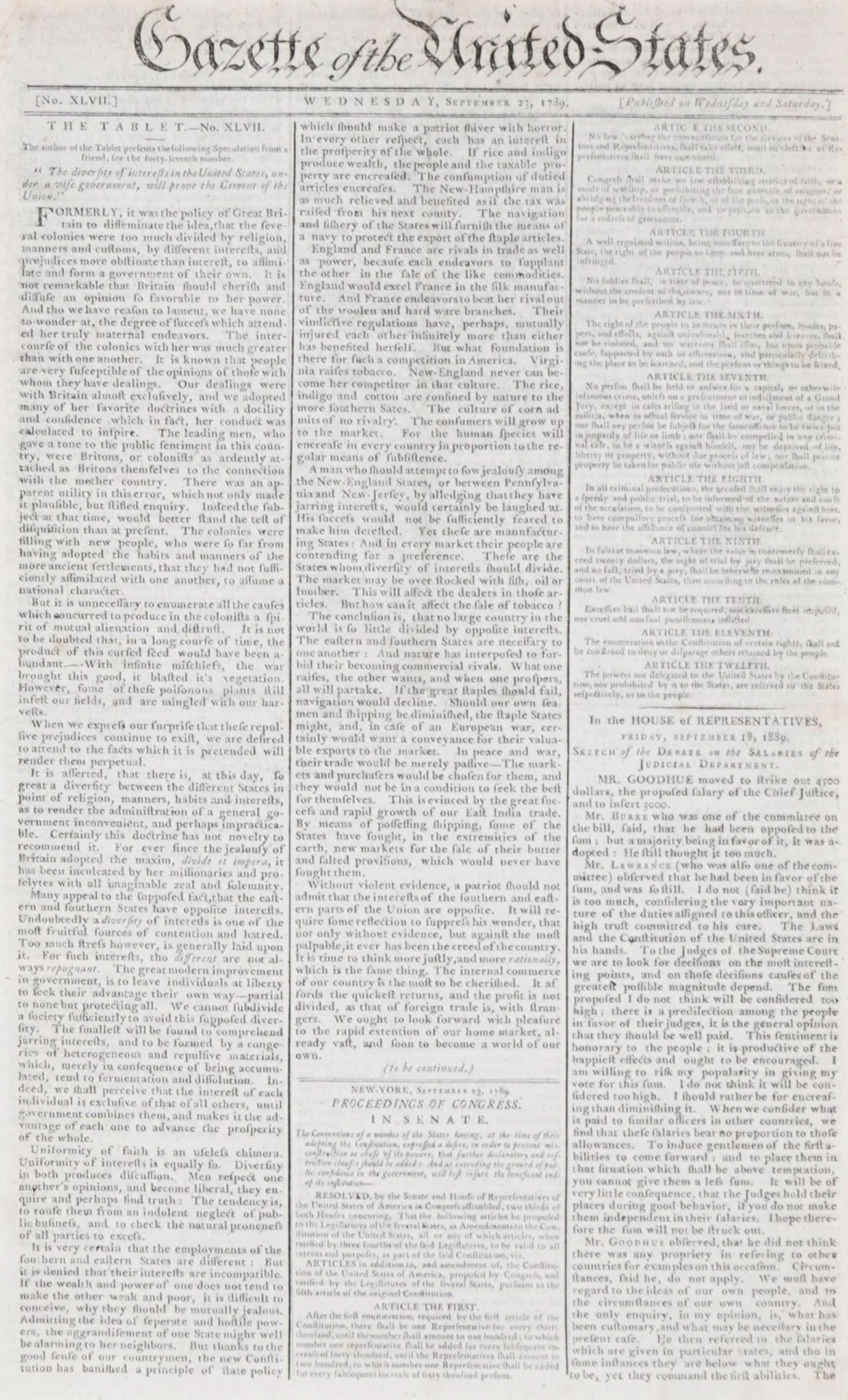
“Article The Third [now the 1st Amendment]. Congress shall make no law establishing articles of faith, or a mode of worship, or prohibiting the free exercise of religion, or abridging the freedom of speech, or of the press, or the right of the people peaceably to assemble, and to petition to the government for a redress of grievances.”
“Article The Fourth [now the 2nd Amendment]. A well regulated militia, being necessary to the security of a free state, the right of the people to keep and bear arms, shall not be infringed.”
James Madison and many others were concerned that a narrow bill of rights might lead officials to abuse the powers of their offices. However, after five state conventions added requests or proposals for a Bill of Rights to their ratifications, Madison recognized that the legitimacy of the Constitution depended on adding a Bill of Rights.
Madison compiled a list of more than 200 proposals, which the House narrowed down to seventeen, and the Senate further reduced to twelve. Only minor changes were made during the two weeks that the committee spent finalizing what would ultimately become the 1st Amendment that we recognize today— e.g., “Congress shall make no law establishing articles of faith, or a mode of worship“ became “Congress shall make no law respecting an establishment of religion.” That was passed two days after this penultimate text was printed.
The first two original proposed amendments (respectively, ensuring a perpetual representation in the House of one representative for every 30,000 citizens; and barring Congress from voting itself a pay raise without an intervening election) were not ratified, though the second became the 27th Amendment in 1992. The remaining ten amendments were ratified on December 15, 1791
★ [BILL OF RIGHTS]. The Gazette of the United States, Sept. 23, 1789, New York. #27215