
 Image 1 of 1
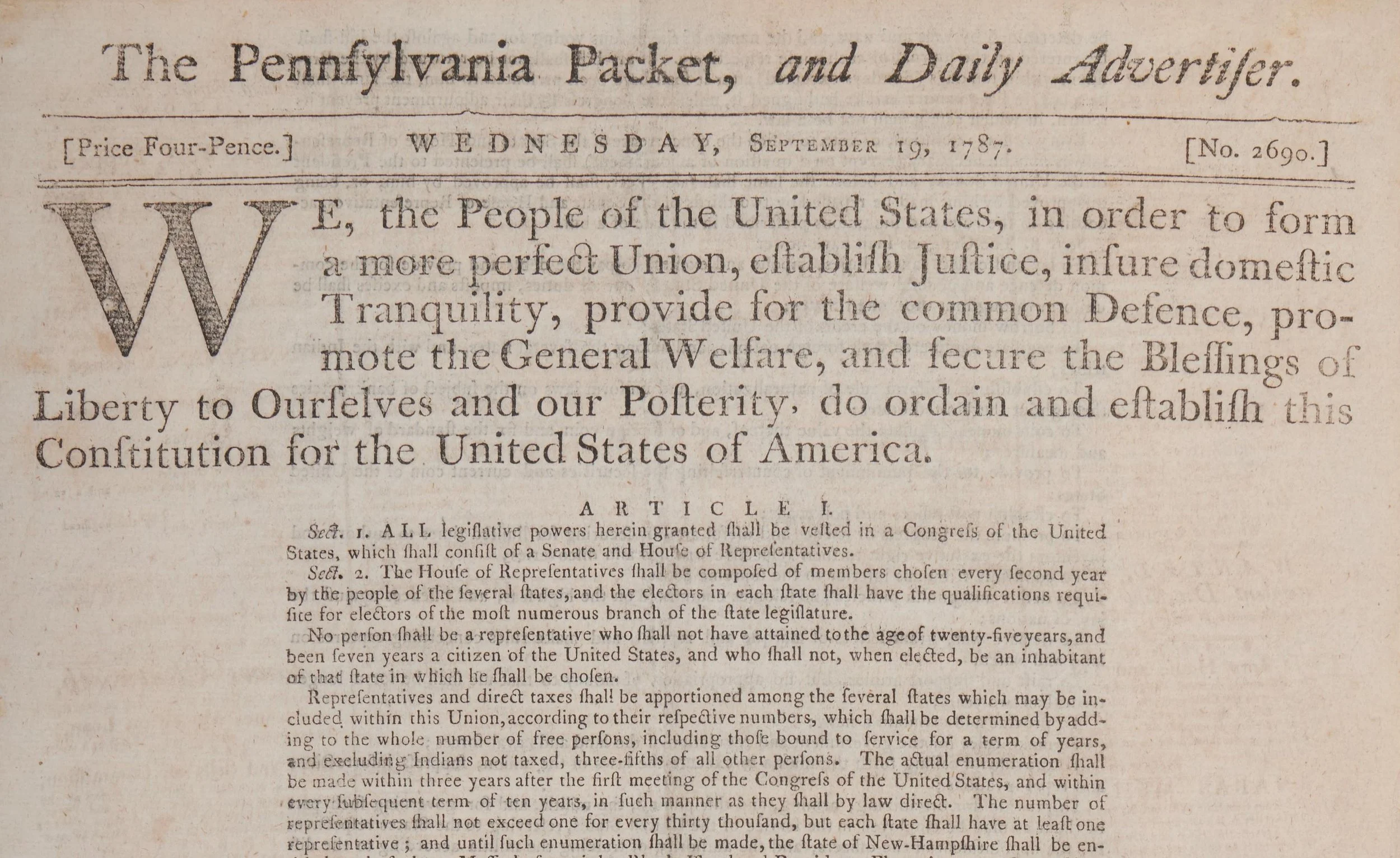
“WE, the People of the United States, in Order to form a more perfect Union, establish Justice, insure domestic Tranquility, provide for the common defence, promote the general Welfare, and secure the Blessings of Liberty to ourselves and our Posterity, do ordain and establish this Constitution for the United States of America.”
After winning independence, thirteen too-loosely associated independent states were unequal to the tasks at hand. Another universal truth soon became evident: Independence is never enough. To be free and secure, we also need a functioning civil society; food, shelter, community, and rule of law and justice. The delegates to the Constitutional Convention, chosen to improve the Articles of Confederation, quickly realized that small changes would not suffice. They created a blueprint for a new system designed to help citizens and the nation meet existential and everyday challenges. The focus went from a Declaration to a Constitution, from independence to interdependence.
The Philadelphia Convention sent their proposal to Congress in New York with Covering Resolutions, signed by George Washington, which resonate just as much today:
“It is obviously impracticable in the federal government of these states, to secure all rights of independent sovereignty to each, and yet provide for the interest and safety of all: Individuals entering into society, must give up a share of liberty to preserve the rest… It is at all times difficult to draw with precision the line between those rights which must be surrendered, and those which may be reserved…
In all our deliberations on this subject we kept steadily in our view, that which appears to us the greatest interest of every true American, the consolidation of our Union, in which is involved our prosperity, felicity, safety, perhaps our national existence … and thus the Constitution, which we now present, is the result of a spirit of amity, and of that mutual deference and concession which the peculiarity of our political situation rendered indispensible. That it will meet the full and entire approbation of every state is not perhaps to be expected; but… that it may promote the lasting welfare of that country so dear to us all, and secure her freedom and happiness, is our most ardent wish.”
To navigate between humility and hubris, faith and doubt, ideals and interests, dogma and compromise, the new nation was designed with separation of powers, and checks and balances. The exhibit module will discuss that along with the necessary compromises of the Constitution, including slavery and the electoral college.
This momentous issue of Dunlap & Claypoole’s Pennsylvania Packet is regarded as the first public printing, as well as the first newspaper printing, of the Constitution. Containing the full text of the Constitution and the transmittal documents, it includes no advertisements or other news. Within 20 days of the close of the convention at least 55 of the approximately 80 newspapers of the period had printed the text.
Upon ratification, the United States of America was established in New York City in 1789. The states were still precariously connected, with citizens of vastly diverse cultural, religious, ethnic, educational and class backgrounds. Even their economic systems and currencies were different. Its success could not be taken for granted.

★ [U.S. CONSTITUTION]. The Pennsylvania Packet, and Daily Advertiser. September 19, 1787. Philadelphia, PA: John Dunlap and David Claypoole. #27904