
 Image 1 of 1
“The question before us is, whether the class of persons described in the plea … compose a portion of this people, and are constituent members of this sovereignty? We think they are not, and that they are not included, and were not intended to be included, under the word ‘citizens’ in the Constitution, and can therefore claim none of the rights and privileges which that instrument provides for and secures to citizens of the United States...
“They had for more than a century before been regarded as beings of an inferior order, and altogether unfit to associate with the white race, either in social or political relations; and so far inferior, that they had no rights which the white man was bound to respect; and that the negro might justly and lawfully be reduced to slavery… He was bought and sold, and treated as an ordinary article of merchandise and traffic, whenever a profit could be made by it. This opinion was at that time fixed and universal in the civilized portion of the white race…”
In 1846, Dred Scott and his wife Harriett sued for their freedom on the grounds that they had been living in free states and territories. When the case finally rose to the Supreme Court in 1857, Chief Justice Roger B. Taney pressed much further than Scott’s immediate case in an attempt to settle the question in favor of preserving slavery once and for all.
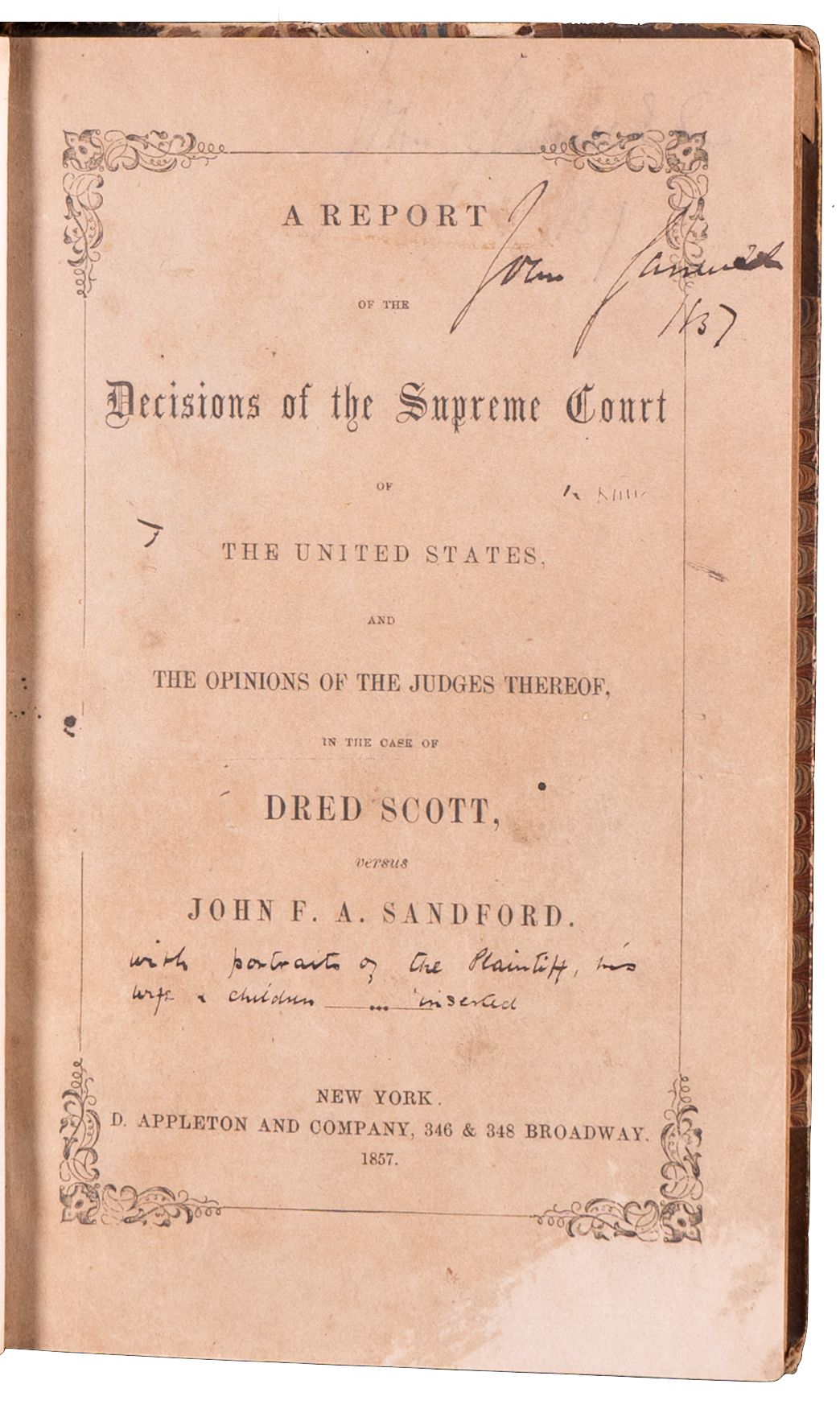
In Dred Scott v. Sandford (1857), Chief Justice Roger Taney wrote for a 6-2 majority, declaring that people of African descent imported into the United States and held as slaves were not protected by the Constitution and could never be citizens of the United States. It also held that Congress had no authority to prohibit slavery in federal territories, declaring the 1820 Missouri Compromise, and any law that prohibited slavery in a territory, to be unconstitutional. Slaves did not become free when taken into free territory, and —as chattel or private property—they could not sue and could not be taken away from their owners without due process. Justices, McLean and Curtis, dissented.
The decision was lauded in the South as solving the slavery question. In reality, it repudiated the compromises that had previously allowed for the expansion of slavery in some places but not others. It taught the North that neither political compromise nor justice could be relied on to settle sectional disputes. Thus, the extreme pro-slavery position of the Court helped to precipitate the Civil War.
★ [U.S. SUPREME COURT]. Report of the Decision of the Supreme Court of the United States and the Opinions of the Judges thereof, in the Case of Dred Scott versus John F.A. Sandford, December Term, 1856. First edition, Washington, D.C. With engraved portraits of Dred and Harriet Scott from Frank Leslie's Illustrated Newspaper, June 27, 1857, inserted on lined blue paper, a portrait of Scott's daughters pasted on page 633, a few early ink annotations. #26591.99