
 Image 1 of 1
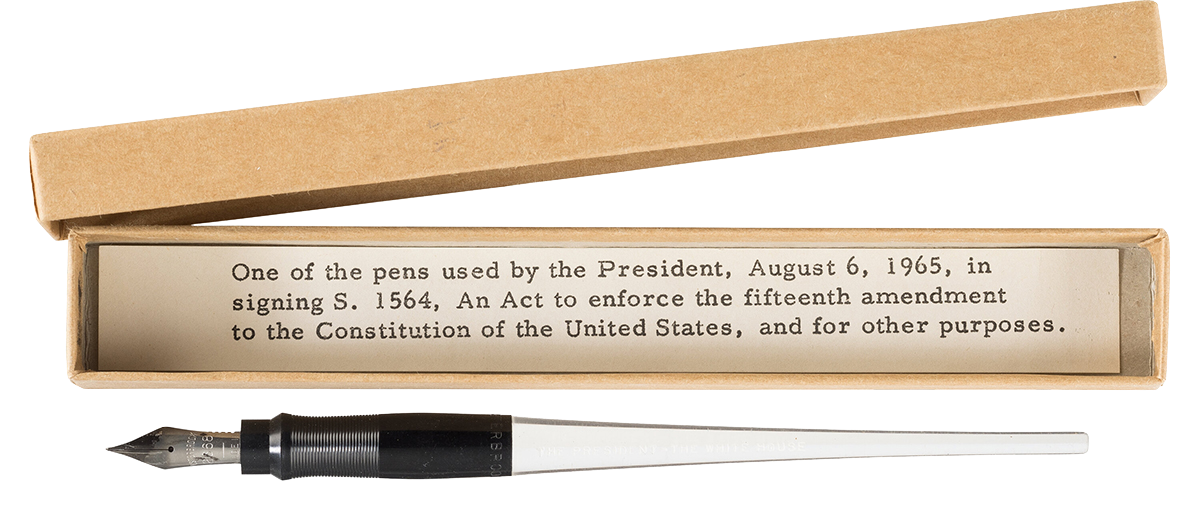
“One of the pens used by the President, August 6, 1965, in signing S. 1564, An Act to enforce the fifteenth amendment to the Constitution of the United States, and for other purposes.”
The Civil Rights Act of 1964 barred discrimination and segregation in education, public facilities, jobs, and housing. It created the Equal Employment Opportunity Commission to ensure fair hiring practices, the Federal Community Relations Service to assist local communities with civil rights issues, and the U.S. Office of Education to distribute funds to aid in desegregating schools. President Kennedy sent the Act to Congress in 1963, where it was held back by the Judiciary Committee. It gained support after the 1963 March on Washington, yet did not pass until July 1964, after Kennedy was assassinated. Even then, the job was still not done.
On March 15, 1965, a week after Bloody Sunday, President Lyndon B. Johnson addressed the nation, declaring that “all Americans must have the privileges of citizenship regardless of race.” He announced that he was sending a new bill to Congress to prevent states and election officials from denying Southern Blacks the vote.
The Voting Rights Act of 1965 outlawed poll taxes, literacy tests, and other means used to disenfranchise Black voters. It authorized the attorney general to send federal officials to help register voters, and the federal government to supervise elections. By the middle of 1966, over half a million African Americans had registered to vote, and by 1968, almost 400 Black people had been elected to office.

★ [VOTING RIGHTS ACT]. Signing pen, in original box with presentation text. With original press photo from signing ceremony. This example was presented to JAMES FARMER, the founder of CORE- The Congress for Racial Equality. #27776