
 Image 1 of 1
“Society is produced by our wants, and government by our wickedness; the former promotes our happiness Positively by uniting our affections, the latter Negatively by restraining our vices…
Government, like dress, is the badge of lost innocence… For were the impulses of conscience clear, uniform and irresistibly obeyed, man would need no other lawgiver… Society in every state is a blessing, but government even in its best state is but a necessary evil…
The cause of America is in a great measure the cause of all mankind. Many circumstances have, and will arise, which are not local, but universal, and through which the principles of all Lovers of Mankind are affected… The laying of a Country desolate with Fire and Sword, declaring War against the natural rights of all Mankind, and extirpating the Defenders thereof from the Face of the Earth, is the Concern of every Man to whom Nature hath given the Power of feeling…”
Before Common Sense, only a third of Americans favored separation from Britain. Over the next six months, it swayed as much as another third. Before calling for independence, Paine first examined the nature and purpose of government, presenting arguments that remain compelling today.
Paine argued that the idea of monarchy was antiquated, and that mankind was approaching an Age of Reason. Only in America, Paine believed, could humans fully escape from the restraints of tradition and ignorance to become enlightened self-governing citizens. He also pointed out, “When we are planning for posterity, we ought to remember that virtue is not hereditary…”
The first edition sold out within days. After a dispute with his publisher Robert Bell, Paine went to another with significant additions to the text, including the phrase, “the Free and Independent States of America.” Here, Bell simply republishes the new additions without permission.
This copy of Common Sense was owned by Robert Yates, who, following Independence, helped draft New York’s first state constitution. In 1787, along with Alexander Hamilton and John Lansing, Jr., Yates was appointed to represent New York at the Constitutional Convention. He and Lansing both opposed a strong national government and soon withdrew. Yates penned numerous Anti-Federalist essays as “Brutus.” He ran for Governor twice, losing to George Clinton and John Jay. He served as Justice of New York’s Supreme Court, and Chief Justice from 1790 to 1798.
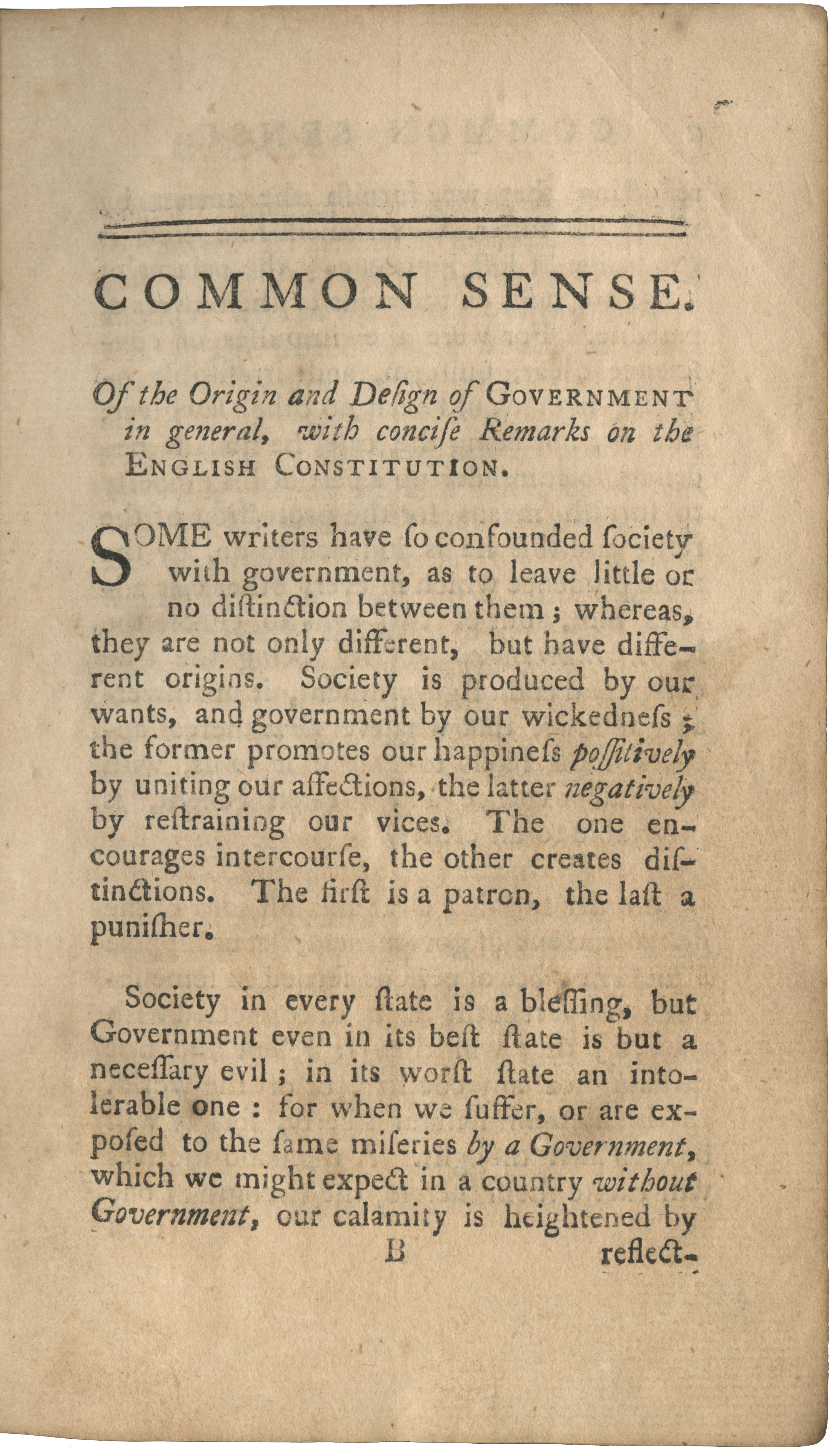
★ [THOMAS PAINE]. Common Sense; Addressed to the Inhabitants of America… Philadelphia: Printed, and Sold, by R. Bell, 1776. Mixed edition, bound with Paine’s Large Additions to Common Sense… and James Chalmers’ Plain Truth; Addressed to the Inhabitants of America..., the principal loyalist response to Common Sense. #27742