
 Image 1 of 1
"... rendered necessary by conventions with the French Republic, involving a cession of Louisiana to the United States; which may require the presence of both Houses, [the shortness of the time] with the very great importance of the subject to the interest of the United States, claim from every member the most punctual attendance; and I am charged by the President to urge these considerations on your patriotism, and your sense of duty...."
The Kingdom of France had claimed control of the Louisiana territory, a wide swath of land west of the Mississippi River, from 1682 until the territory was ceded to Spain in 1762. In 1800, Napoleon Bonaparte, the First Consul of the French Republic, regained the Louisiana territory in exchange for Tuscany. However, a revolt in Saint-Domingue and renewed warfare with the United Kingdom led Napoleon to consider selling the territory to the United States. President Thomas Jefferson was eager to gain control of the port of New Orleans at the mouth of the Mississippi River, but his diplomats quickly agreed to purchase the entire Louisiana territory.
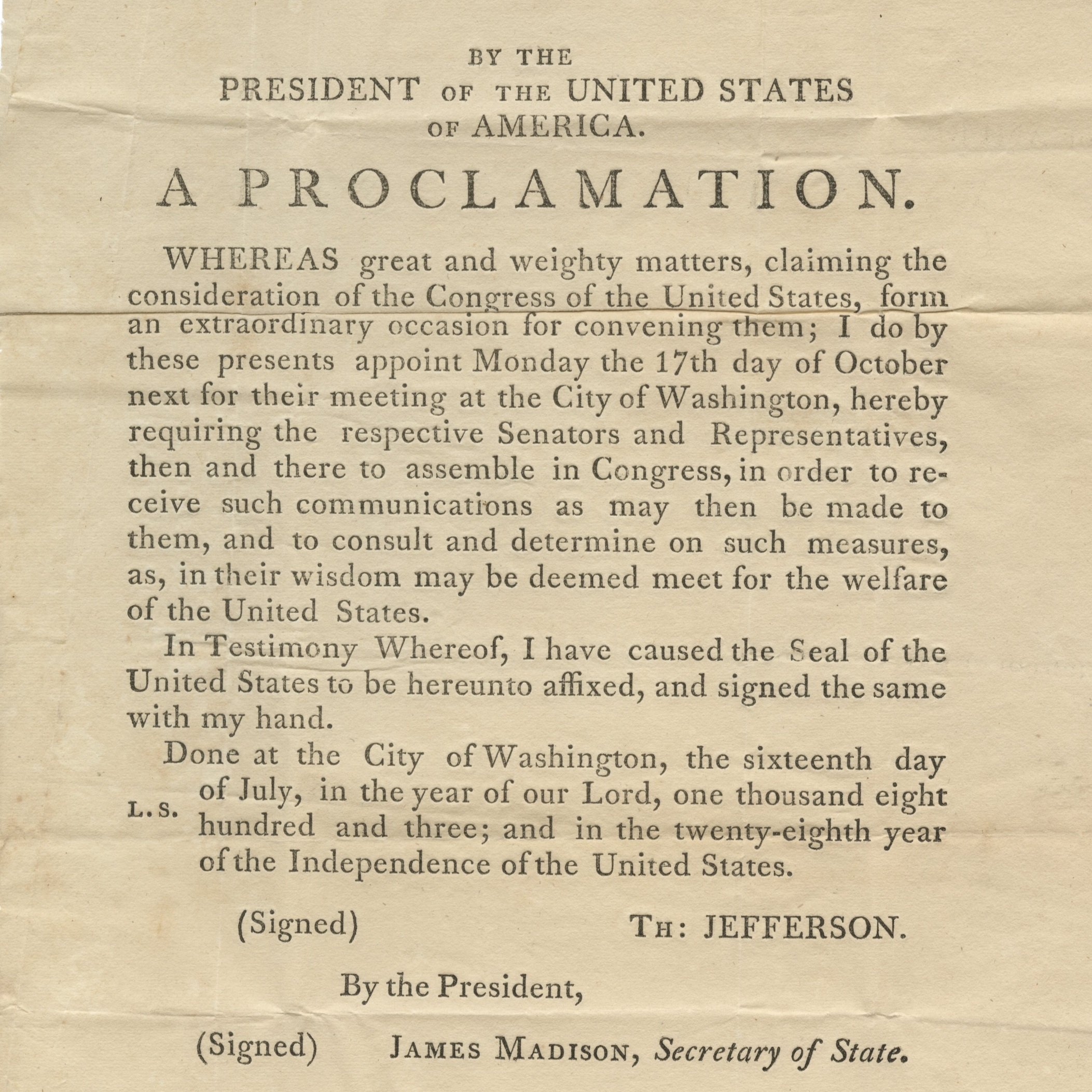
A special session of Congress called to ratify the Louisiana Purchase convened on October 17, 1803. The Louisiana Purchase more than doubled the size of the United States, set our collective eyes forever westward, and was undoubtedly Jefferson's most significant achievement as President. The session duly convened and just three days later on October 20, 1803, the Senate ratified the Treaty by a vote of 24-to-7. On October 25 the House approved the payment of $11 million with a 90-to-25 vote and within a week of that was the first triumphant public announcement in the National Intelligencer.
The Louisiana Purchase gave the United States nominal title to 828,000 square miles, nearly doubling the size of the nation. Jefferson and Secretary of State James Madison overcame Federalist opposition to convince the U.S. Senate to ratify the treaty on October 20, 1803, by a vote of 24 to 7. This purchase included some or all of fifteen modern U.S. states and a small portion of two modern provinces in Canada. Soon, the federal government began to send expeditions to explore and map the new territory, the most famous of which was the Lewis and Clark Expedition of 1804-1806.
An exceptional survival of the broadside and letter.

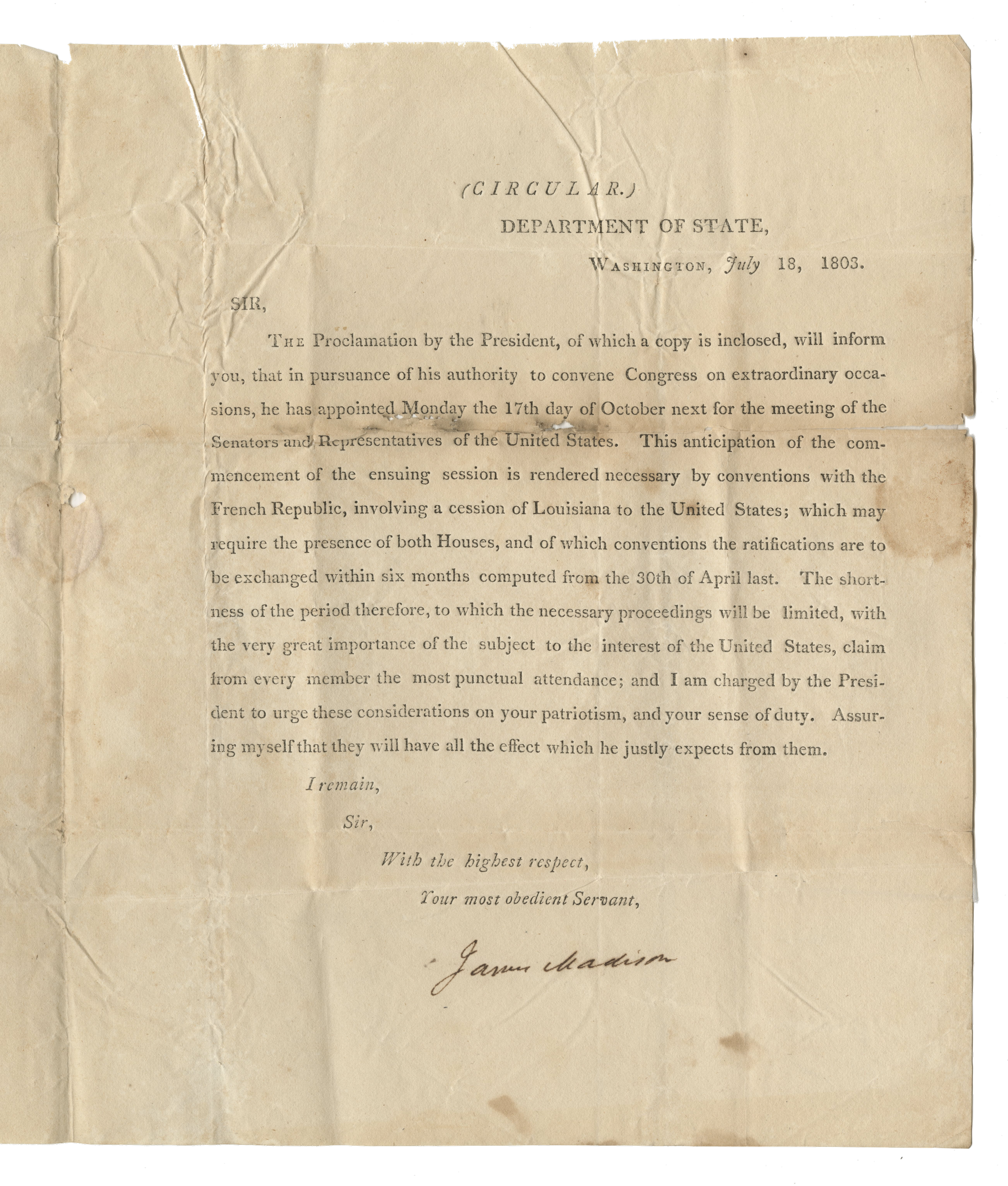

★ JAMES MADISON. Printed Letter Signed as Secretary of State, 1 p, with additional Madison franking signature, Washington, D.C., July 18, 1803, to Benjamin [George] Tibbits, on Amies wove paper with dove of peace watermark. #24160.01
WITH:
THOMAS JEFFERSON. Broadside, By the President of the United States of America. A Proclamation... Washington, D.C., July 16, 1803. Signed in type by Jefferson and Madison. #24160.02