
 Image 1 of 1
“YOU are already too well acquainted with the melancholly and very alarming Circumstances to which this Province, as well as America in general, is now reduced. Taxes equally detrimental to the Commercial Interests of the Parent Country and her Colonies are imposed upon the People, without their Consent…”
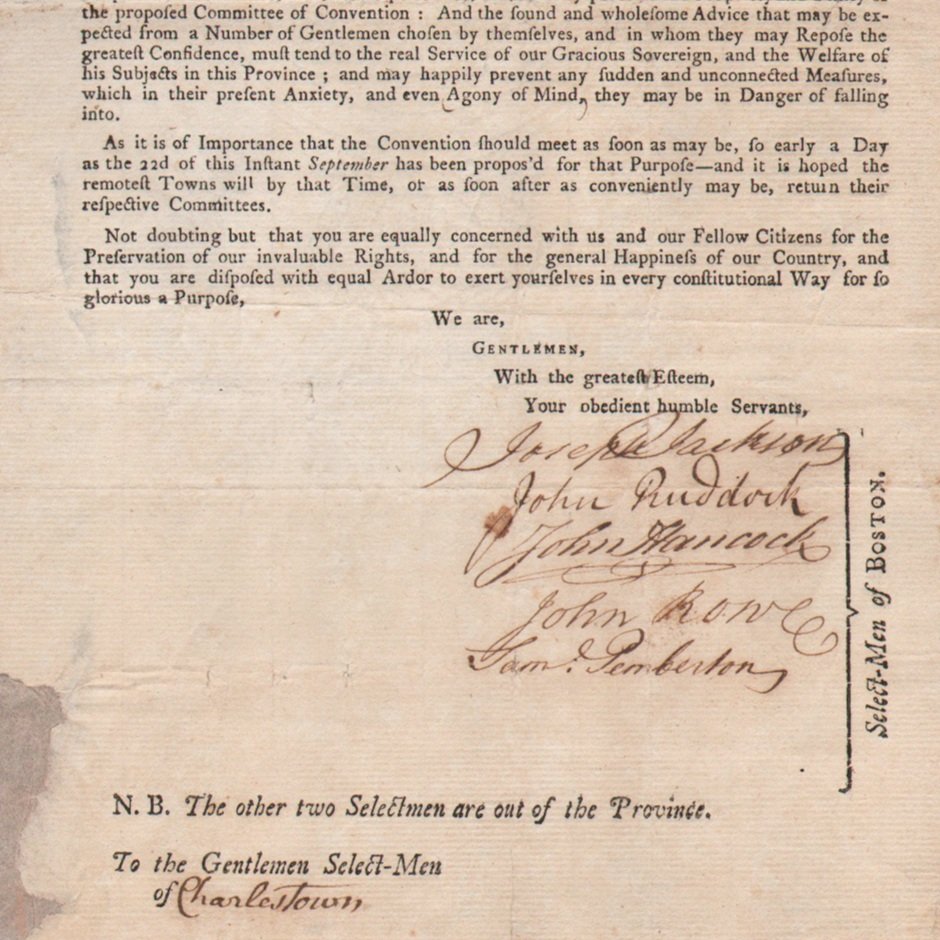
A crucial precursor to independence, this circular letter to all the towns in Massachusetts called for a convention to support Boston and come up with a joint response. The selectmen of Boston lay out key issues: the “unconstitutional” imposition of taxes, obstruction of petitions for redress, dissolution of representative government, and introduction of a standing army to enforce the oppressive mandates—“one of the greatest Distresses to which a free People can be reduced.”
The call was immediately answered. On September 23, representatives from 96 Massachusetts towns met in Boston’s Faneuil Hall. While it was meeting, British warships arrived in Boston Harbor. On September 30, two regiments of Redcoats came ashore at the Long Wharf, beginning the military occupation of Boston, which lasted for eight years. The convention hastily passed several resolutions and adjourned.
The Boston selectmen’s successful call for a colony-wide convention represents an important precedent for the creation of ad hoc governing institutions in revolutionary America, from the Committees of Correspondence and Committees of Safety to the Continental Congresses. In bypassing royal prerogative to constitute a political body capable of representing the popular will, Massachusetts patriots sowed the seeds for republican government and independence in America.
“No taxation without representation” is now thought of as the catchphrase for the patriot cause. Though often attributed to James Otis, no proof of his using the phrase has been found. The February 1768 London Magazine contains the earliest known printing, in a subhead introducing a speech on the declaratory bill. Lord Camden stated that “taxation and representation are inseparably united,” and the editor added “no taxation without representation.” The first known usage relating to America was printed in 1771 for the prior year’s The Political Register and Impartial Review, in A Dissertation on the original Dispute between Great-Britain and her Colonies, by Demophoon. The substance of the rallying cry is captured here, in the argument that the punitive taxes have been imposed “upon the people without their Consent … in a Manner clearly unconstitutional…”

★ JOHN HANCOCK. Printed Document Signed as Selectman of Boston, September 14, 1768. Cosigned by Boston Selectmen Joseph Jackson, John Ruddock, John Rowe, and Samuel Pemberton. Only one other signed copy is presently known in private hands, and just four are recorded in institutional collections. #27558