
 Image 1 of 1
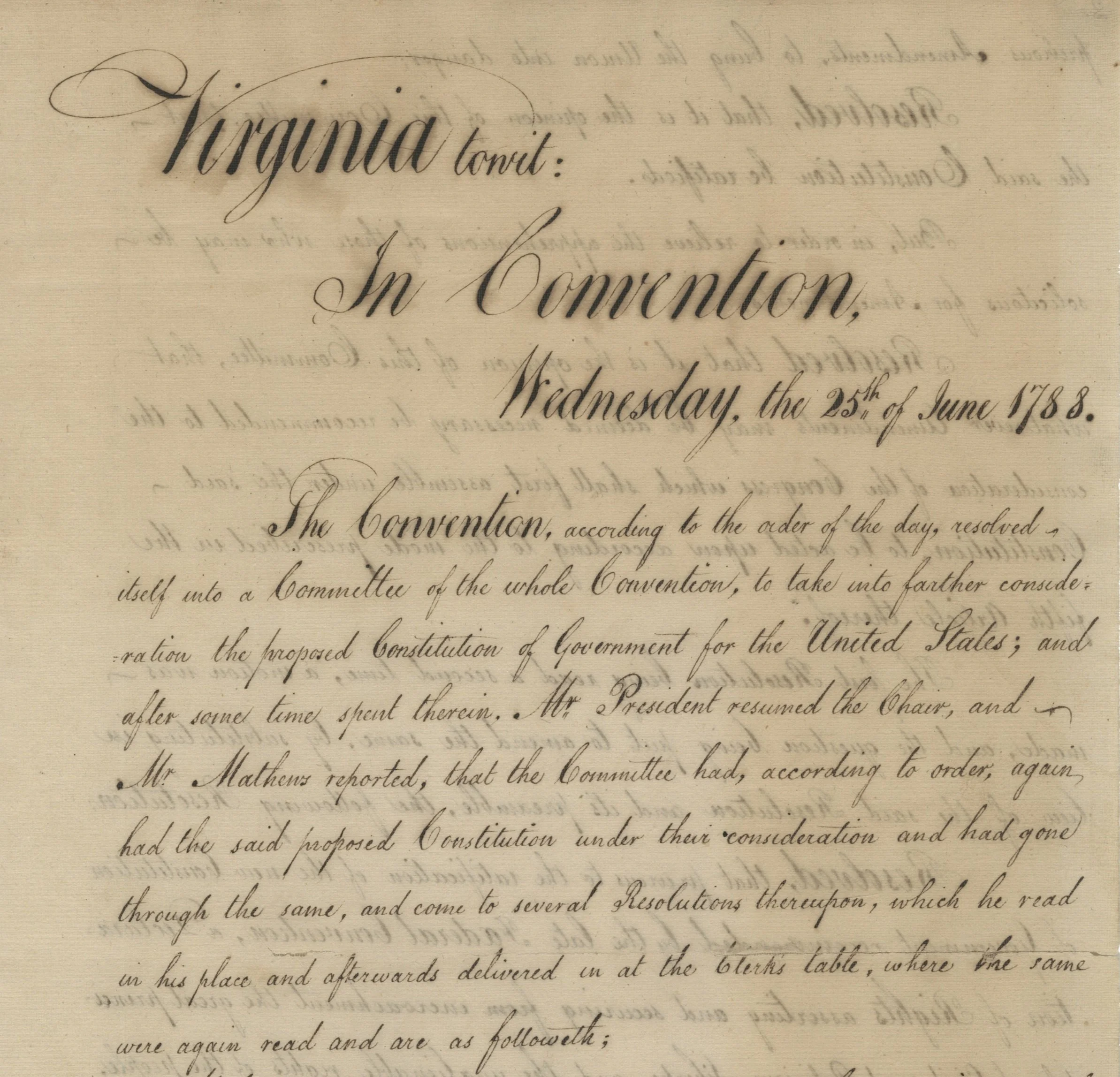
Official attested copy signed by Virginia Ratification Convention president Edmund Pendleton and secretary John J. Beckley announcing that Virginia had ratified the Constitution.
170 delegates convened at the State House in Richmond on June 2, 1788. On the first day, they unanimously elected Edmund Pendleton as president. Though he had refused to sign the Constitution in Philadelphia, he supported its adoption by Virginia only months later. The Convention met six days a week. James Madison, who had introduced the “Virginia Plan” at the Constitutional Convention, led the Federalists who favored unconditional ratification. Patrick Henry led the Antifederalists who opposed ratification without some essential guarantees of personal liberty.
On June 24, George Wythe (Declaration signer and Jefferson’s law instructor) proposed that the delegates “should ratify the Constitution, and that whatsoever amendments might be deemed necessary, should be recommended to the consideration of Congress which should first assemble under the Constitution...” Patrick Henry responded with a proposal “to refer a declaration of rights, with certain amendments … to the other States in the Confederacy, for their consideration, previous to its ratification.”
On June 25, the Convention rejected the Antifederalist resolution, and approved ratification by a vote of 89 to 79. The Convention appointed James Madison, Edmund Randolph, George Nicholas, John Marshall, and Francis Corbin to compose Virginia’s ratification resolution. The Convention adopted their proposal, found on the third and fourth pages of this document.
The Convention also appointed a committee of twenty, including both Federalists and Antifederalists, to prepare recommended amendments. Chaired by George Wythe, the committee included the most prominent voices of the Convention—Patrick Henry, Edmund Randolph, George Mason, James Madison, and James Monroe.
On the final day of the Convention, Wythe reported “such Amendments … deemed necessary to be recommended to the consideration of the Congress which shall first assemble under the said Constitution, to be acted upon according to the mode prescribed in the fifth article…”
The proposed amendments were in two groups. The first twenty comprised “a Declaration or Bill of Rights asserting and securing from encroachment the essential and unalienable rights of the people,” and the second set proposed twenty structural amendments to the Constitution. Both sets closely reflected the work of an Antifederalist committee chaired by George Mason early in the Convention.
The delegates of Virginia thought their vote made Virginia the ninth state to ratify, thus meeting the two-thirds of the states required to put the Constitution into effect. They later learned that New Hampshire’s Convention had already ratified on June 21, 1788, giving New Hampshire the honor of becoming the necessary ninth state.
However, Virginia was the most populous and wealthiest of the thirteen original states. Without its approval, the new government would have had little chance of success. In addition, Virginia’s ratification had a crucial effect on the pivotal decision one month later by New York to ratify the Constitution.
Virginia was not the only state to ratify the Constitution with the understanding that amendments should or would be adopted almost immediately, ranging from South Carolina’s four to New York’s fifty-seven proposed amendments. However, Virginia’s proposed “Declaration or Bill of Rights” is most closely reflected in what became the federal Bill of Rights.
Excerpts from Constitution:
“Whereas the powers granted under the proposed Constitution are the gift of the people, and every power granted thereby remains with them, and at their will; no right, therefore, of any denomination can be cancelled, abridged, restrained or modified by the Congress, by the Senate or House of Representatives, acting in any capacity, by the President, or any Department or Officer of the United States, except in those instances in which power is given by the Constitution for these purposes: And among other essential Rights, liberty of Conscience and of the Press cannot be cancelled, abridged, restrained or modified, by any authority of the United States…”
“We the said Delegates, in the name and in behalf of the People of Virginia, Do by these pre-sents assent to and ratify the Constitution recommend-ed on the seventeenth day of September, one thousand seven hundred and eighty seven by the Fœderal Convention for the Government of the United States; hereby announcing to all those whom it may concern, that the said Constitution is binding upon the said People…”
Excerpts from Bill of Rights:
“Whereas the powers granted under the proposed Constitution are the gift of the people, and every power granted thereby remains with them, and at their will; no right, therefore, of any denomination can be cancelled, abridged, restrained or modified by the Congress, by the Senate or House of Representatives, acting in any capacity, by the President, or any department or Officer of the United States, except in those instances in which power is given by the Constitution for these purposes: And among other essential Rights, liberty of Conscience and of the Press cannot be cancelled, abridged, restrained or modified, by any authority of the United States…
Sixth, That Elections of representatives in the legislature ought to be free and frequent, and all men having sufficient evidence of permanent common interest with and Attachment to the Community, ought to have the right of Suffrage…
Twelfth, That every freeman ought to find a certain remedy by recourse to the laws for all injuries and wrongs he may receive in his person, property or character. He ought to obtain right and justice freely without sale, completely and without denial, promptly and without delay, and that all establishments or regulations contravening these rights, are oppressive and unjust…
Twentieth, That religion, or the duty which we owe to our Creator, and the manner of discharging it, can be directed only by reason and conviction, not by force or violence, and therefore all men have an equal, natural and unalienable right to the free exercise of religion according to the dictates of conscience, and that no particular religious sect or society ought to be favored or established by law in preference to others…”

p.1

p.5

p.13
★ [VIRGINIA RATIFICATION CONVENTION]. EDMUND PENDELTON. Manuscript Document Signed, Extracts of Proceedings of Virginia Ratification Convention, June 25-27, 1788. Also signed and attested by John Beckley as secretary. #27341.99
This is one of only three known surviving sets that the Convention ordered to be engrossed and sent to the other states and to the Confederation Congress.