
 Image 1 of 1
“…though the will of the majority is in all cases to prevail, that will, to be rightful, must be reasonable…the minority possess their equal rights, which equal law must protect, and to violate would be oppression.
Let us then, fellow-citizens, unite with one heart and one mind; let us restore to social intercourse that harmony and affection without which liberty, and even life itself, are but dreary things. And let us reflect, that having banished from our land that religious intolerance under which mankind so long bled and suffered, we have yet gained little, if we countenance a political intolerance, as despotic, as wicked, and capable of as bitter and bloody persecutions…every difference of opinion is not a difference of principle. We have called by different names brethren of the same principle. We are all republicans; we are all federalists. If there be any among us who would wish to dissolve the Union, or to change its republican form, let them stand undisturbed as monuments of the safety with which error of opinion may be tolerated, where reason is left free to combat it…”
The acrimonious presidential election became known as the “Revolution of 1800” for ushering in the first peaceful transfer of power from one party to another—with few parallels in the history of the world.
Federalist campaigners characterized Jefferson as a subversive enemy to the republic, urging voters to choose “God—and a religious President” over “Jefferson—and no God.” The election became even more controversial when Aaron Burr received an equal number of electoral votes. Though Jefferson was known as the presidential candidate and Burr the Vice Presidential candidate, the Constitution was not clear on that point. The election was thus thrown into the House of Representatives, which took a week—and 36 ballots—to decide in Jefferson’s favor, after Hamilton signaled his support for Jefferson over Burr..
This, Jefferson’s most famous speech, lays out his political program while making a ringing call for patriotism beyond partisanship. Considered one of the most important presidential speeches, it has been quoted by Presidents Reagan, Clinton, Bush, and almost every other current political figure.
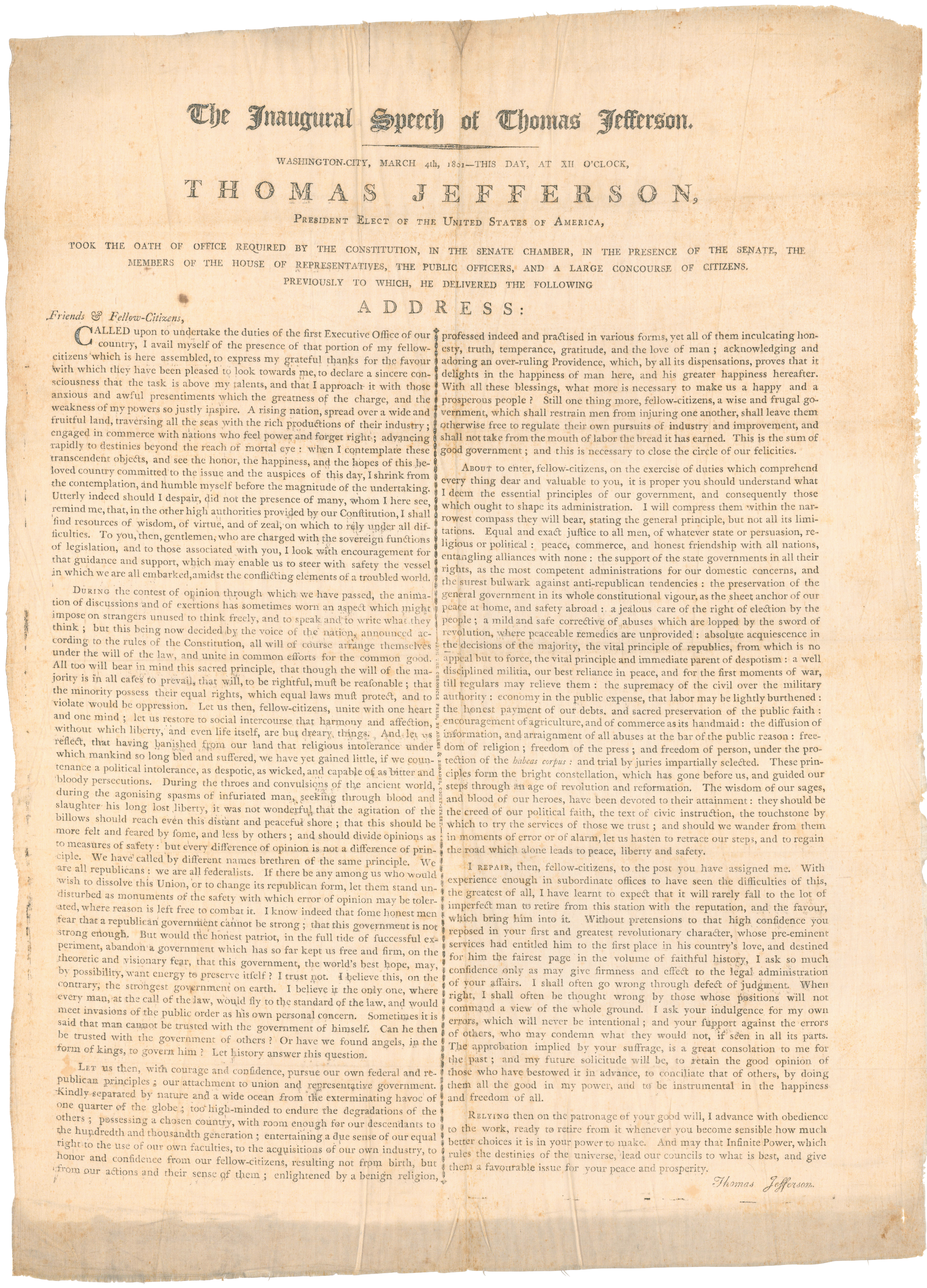
★ THOMAS JEFFERSON. Broadside, “The inaugural speech of Thomas Jefferson. Washington-City, March 4th, 1801...” [Boston]: From the Chronicle Press, by Adams & Rhoades, Court-Street. [March 19, 1801]. On silk. #21089.99