
 Image 1 of 1
“We hold these truths to be self-evident, that all men are created equal, that they are endowed by their Creator with certain unalienable Rights, that among these are Life, Liberty and the pursuit of Happiness…”
In the greatest break-up note in history, when the Signers of the Declaration of Independence proclaimed the self-evident truth, that all men are created equal, they knew those words described an aspiration, not a reality.
Even the most progressive of the Founders were constrained by the prejudices of their day. Despite their limitations, they put their lives on the line to support novel ideas about human rights and the revolutionary concept that a government should exist to benefit its citizens rather than its rulers.
For much of the last 250 years, “all men are created equal” was seen as a positive vision and inspiration to progress. Now, too many are willing to write that off, focusing instead on the Signers’ hypocrisy, mistakes, and shortcomings. That, we believe, diminishes the fact that the Declaration was central to the idea of America, and a beacon to expanding liberties here and around the world. By looking at it through the lens of the Promise of Liberty, perhaps we can find a better balance.
Excerpt from Declaration’s Grievances:
“He has obstructed the Administration of Justice … He has made Judges dependent on his Will alone…
He has affected to render the Military independent of and superior to the Civil power.
He has combined with others to subject us to a jurisdiction foreign to our constitution, and unacknowledged by our laws…
For cutting off our Trade with all parts of the world:
For imposing Taxes on us without our Consent: For depriving us in many cases, of the benefits of Trial by Jury:
For transporting us beyond Seas to be tried for pretended offences…
He has excited domestic insurrections amongst us…
A Prince whose character is thus marked by every act which may define a Tyrant, is unfit to be the ruler of a free people.”
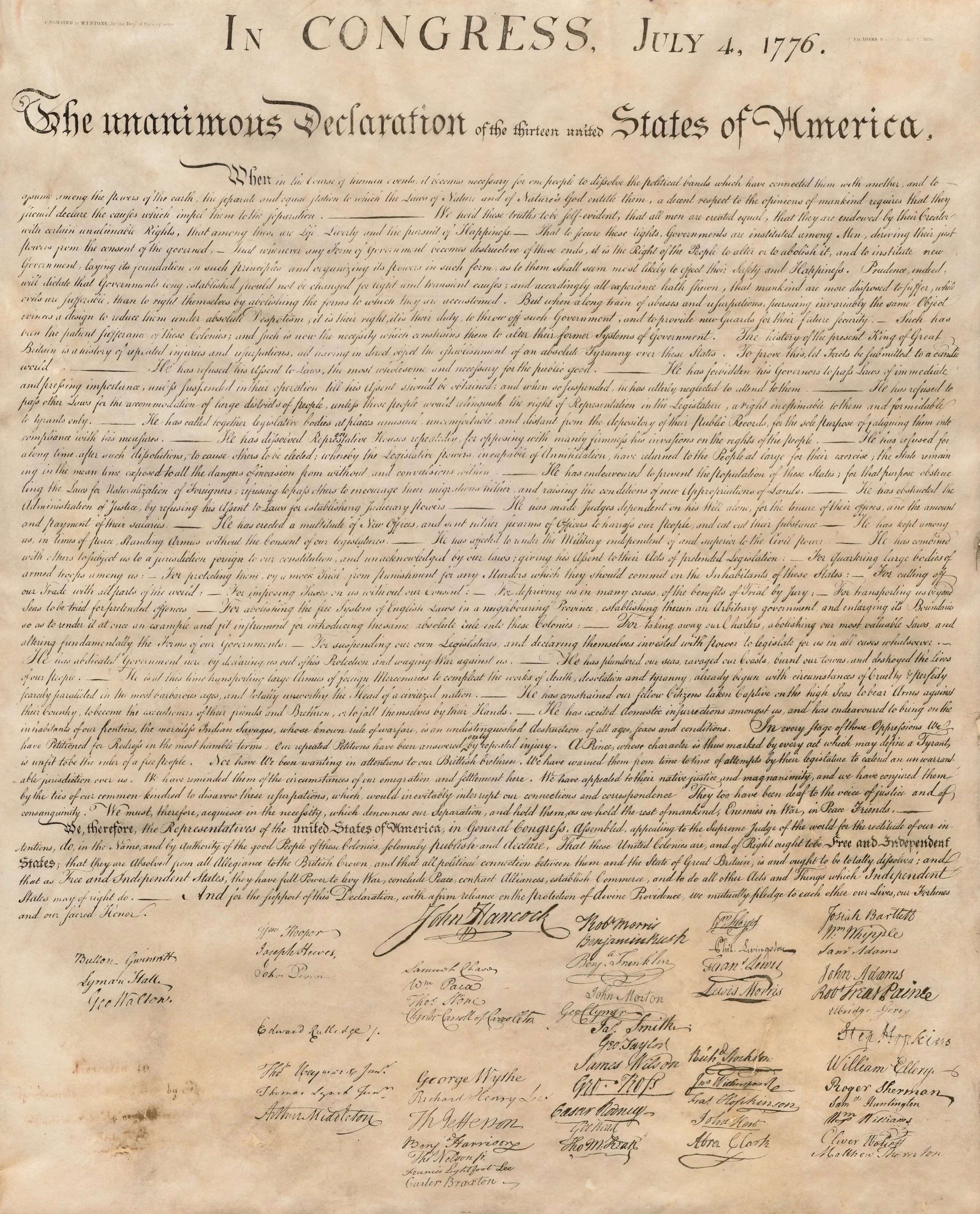
William J. Stone “Exact” Facsimile of the Declaration of Independence
The Declaration was spread starting on July 5th via broadsides, newspapers, magazines and books. The engrossed document was created after New York changed its vote to make it unanimous. Then the parchment was tucked away, traveling with Congress, and more than once being spirited away to avoid capture by British troops over the course of two wars.
After the founding, the Louisiana Purchase doubled the nation’s size, the country survived our second great conflict with Great Britain—the War of 1812, and emerged truly independent into an optimistic period that became known as the “Era of Good Feelings.”
As the 50th anniversary of independence approached, the U.S. was on the verge of enormous physical, political, and economic expansion, and a new generation sought connections to our nation’s founding. The Declaration of Independence, with its not-yet-famous signatures, soon became renowned.
By 1820, the engrossed Declaration of Independence already showed signs of age and wear from handling. Secretary of State John Quincy Adams, with Congressional approval, hired William J. Stone to engrave a facsimile—an exact copy. Stone held the original document for more than two years as he expertly engraved his copperplate facsimile by hand. Congress ordered 200 copies printed on vellum. In 1824, they were distributed to the three surviving signers (Adams, Jefferson and Charles Carroll of Carrollton), the Marquis de Lafayette, presidents and vice presidents, the Senate, House of Representatives, governors, and educational institutions, among others. Approximately 52 of the vellum first editions are known to survive.
Later, people started to believe that Stone was responsible for damaging the original “National Treasure,” assuming he used a chemical process that transferred ink from the original. Evidence to the contrary shows that the damage was caused by decades of display in direct sunlight and other mistreatment.
All subsequent “exact” facsimiles of the Declaration descend from Stone’s work.
This unique copy has a very faint inscription at bottom left. The name of the person to whom it was addressed still has not been deciphered, but a close study reveals this to be the only example with an original inscription penned and signed by John Quincy Adams.
★ [DECLARATION OF INDEPENDENCE]. William J. Stone. Copperplate engraving. First edition of the first exact facsimile, 1823, legend at top left: “ENGRAVED by W.J. STONE for the Dept. of State by order,” continued at top right: “of J. Q. Adams, Sec of State July 4, 1823.” With unique inscription by John Quincy Adams at bottom left. #21310