
 Image 1 of 1
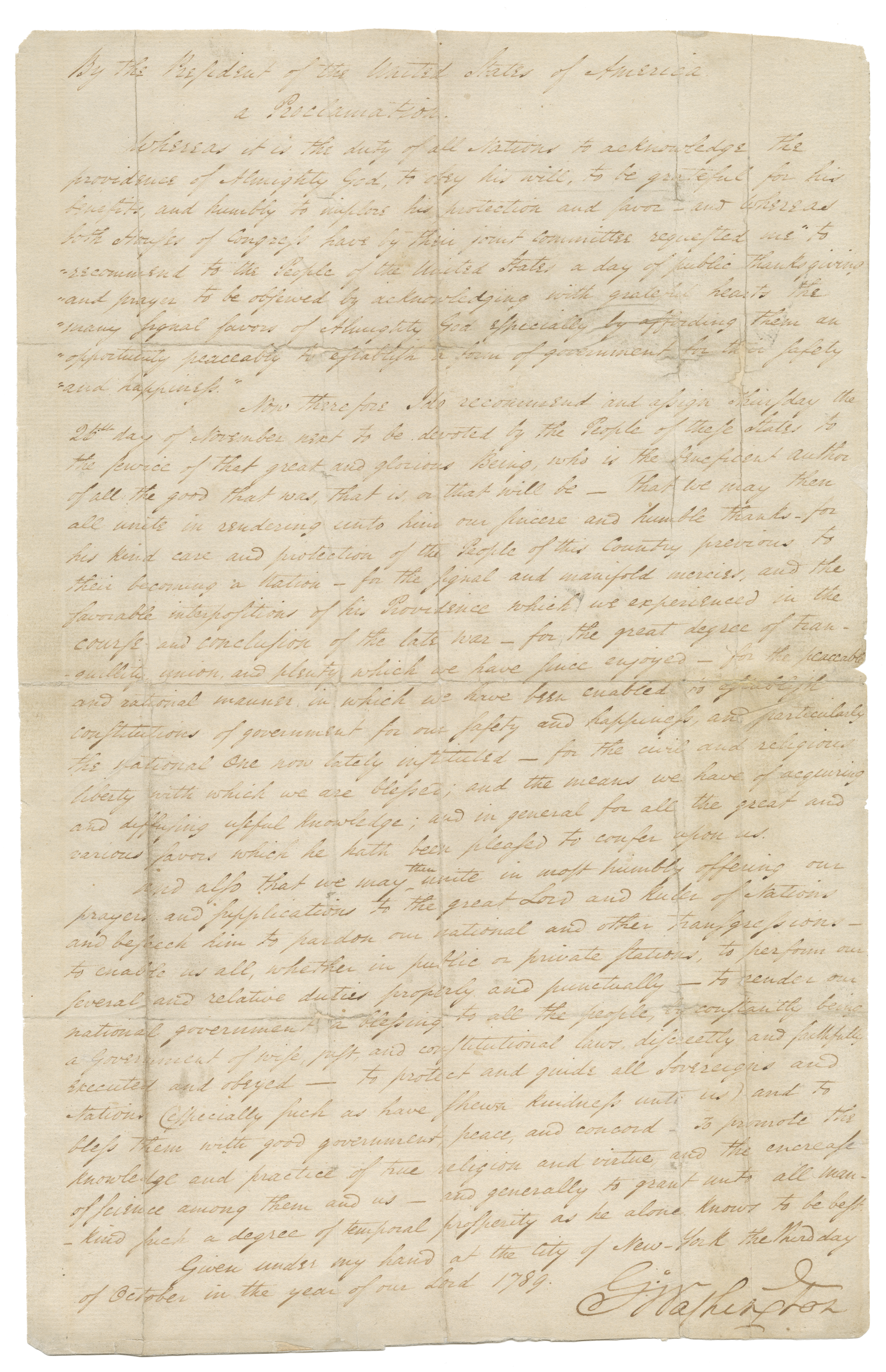
On the day Congress approved the proposed Bill of Rights, just before the first session of the first Federal Congress–arguably the most productive legislative body in the history of the world–came to a close, they requested the president issue a Thanksgiving Proclamation.
Here, George Washington calls on all Americans to give thanks for “the peaceable and rational manner in which we have been enabled to establish constitutions of government for our safety and happiness... for the civil and religious liberty with which we are blessed; and the means we have of acquiring and diffusing useful knowledge.”
And he asks us to pray “to the great Lord and Ruler of Nations … to render our national government a blessing to all the people, by constantly being a Government of wise, just, and constitutional laws, discreetly and faithfully executed and obeyed – to protect and guide all Sovereigns and Nations (especially such as have shewn kindness unto us) and to bless them with good government, peace, and concord – To promote the knowledge and practice of true religion and virtue, and the encrease of science among them and us – and generally to grant unto all mankind such a degree of temporal prosperity as he alone knows to be best…”
As the Declaration of Independence had done 13 years earlier, this often-overlooked founding document set forth an aspirational statement of purpose. The new republic would be composed of citizens who performed “our several and relative duties properly and punctually” with a government of “wise, just, and constitutional laws, discreetly and faithfully executed and obeyed.” It asks God to encourage “all Sovereigns and Nations (especially such as have shewn kindness unto us)” to have “good government, peace, and concord” and to “promote the knowledge and practice of true religion and virtue, and the encrease of science among them and us...”
Washington’s proclamation both reflects and attempts to shape a forward-looking spirit of civic virtue grounded in moral principles. It laid the foundation for the modern national holiday, which became an official annual event in 1863 under President Abraham Lincoln.
Historical Background
In the musical Hamilton, King George III warns the Patriots, “I will kill your friends and family to remind you of my love.” Lin Manuel Miranda thus captured a reality of thousands of years of human history: governments existed to benefit rulers. The Thanksgiving Proclamation shows that America was meant to be different.
The Thanksgiving Proclamation is religious, though not narrowly denominational, consistent with Washington’s belief in a God who superintended the universe and to whom people owed devotion and responsibility. It ties directly to the sentiments he expressed in many letters to religious groups within the United States, including the Rhode Island synagogue to which he pledged that the government of the United States would give “to bigotry no sanction, to persecution no assistance.”
George Washington marked the chosen day, November 26, by attending St. Paul’s Chapel, where the chaplain of the Senate, Episcopal Bishop Samuel Provoost, led a service. Washington noted in his diary that the day was “inclement and stormy,” and few others attended. He also gave $25 to relieve the poor, and donated beer and food to the city’s imprisoned debtors.
★ GEORGE WASHINGTON. Manuscript Document Signed, New-York, October 3, 1789. #23201.99