
 Image 1 of 1
Our break-up from Great Britain was critical, but the claim that “inherent natural rights” were more fundamental than the laws of any government was what made the Declaration truly revolutionary.
Even the most progressive Founders were constrained by the prejudices of their day. Despite their limitations, they put their lives on the line to support novel ideas about human rights and the revolutionary concept that a government should exist to benefit its citizens rather than its rulers. By giving voice to the idea that “all men are created equal,” the Declaration of Independence changed the world.
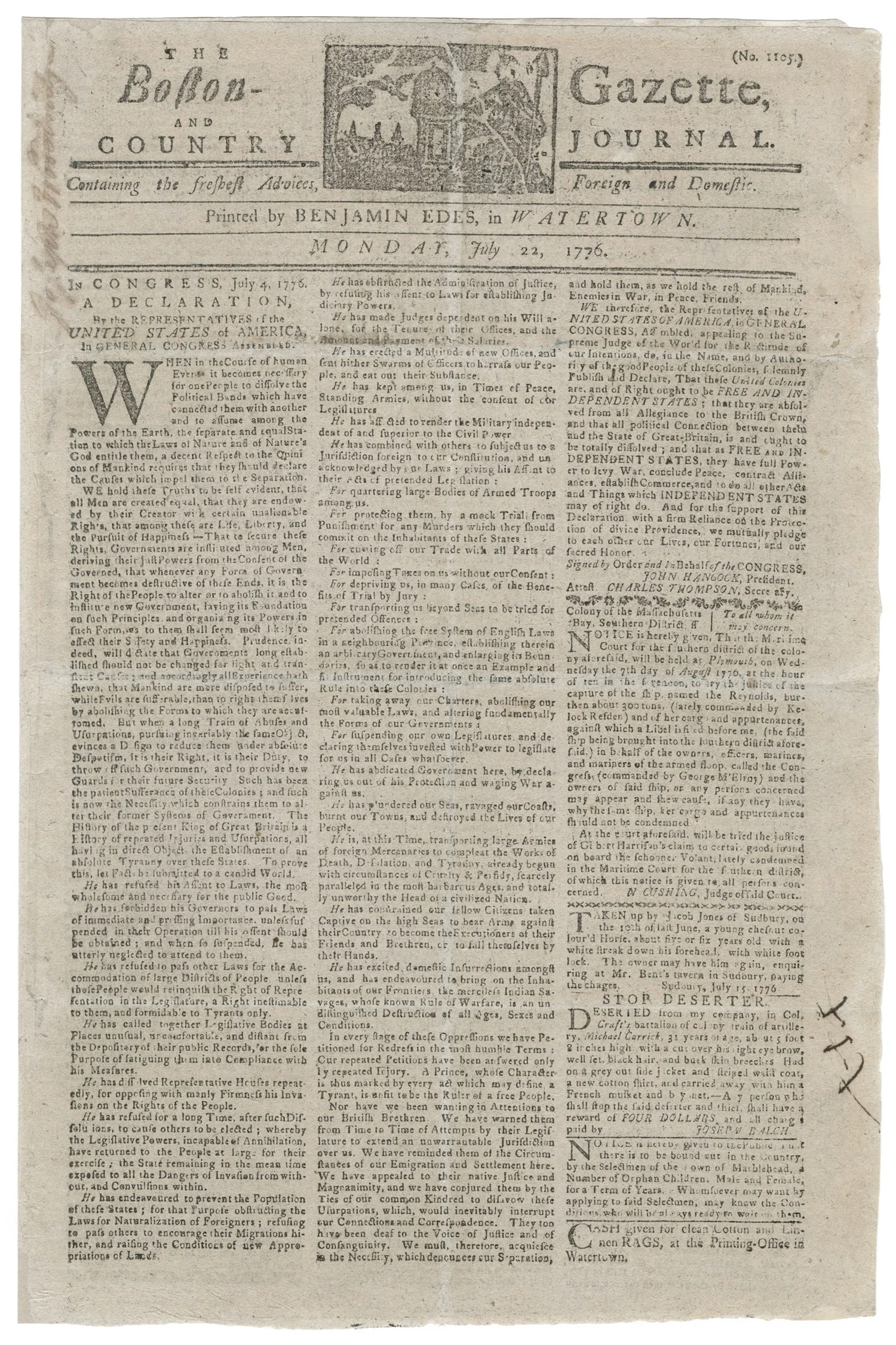
Benjamin Edes had suspended the Gazette’s publication on April 17, 1775, two days before Lexington and Concord. Fearing arrest as the British barricaded the city, Edes made a dramatic escape by boat, carrying a press and some trays of lead type. He resumed publication in a temporary shop in Watertown, 30 miles from Boston.
Start Spreading the News
Newspapers and broadsides were the best technology to quickly spread important news before the internet, phones, television, and radio. They were read, shared, and posted in public forums.
In several ways, July 1776 broadsides and newspapers are more original than the “National Treasure” that most people think of as the original Declaration, though that was actually created a month later for posterity.
A key difference is in the heading of the July 1776 printings: “A Declaration By the Representatives….” New York had abstained. Once news that the other 12 states had agreed, New York added its assent. Congress then ordered the Declaration engrossed (written formally in a large clear script) with new heading, “The Unanimous Declaration.” That was signed on August 2nd.
No 1776 printings list the signers' names. All vary in layout, spelling, punctuation, etc., with occasional errors seeping in. The most frequent differences are in capitalization, which was far less standardized at the time. Thomas Jefferson often didn’t even capitalize words at the beginning of sentences. His polar opposite, John Adams, used what we call “internal caps” for effect in the middle of sentences.
This Boston Gazette issue includes two acts passed by the state’s General Assembly: “An Act to Prevent the Continuance of the Small-Pox, in the Town of Boston, and to Licence Inoculation There…” and “An Act Impowering the Justices… to Permit One or More Inoculating Hospitals, to be Erected in Each of the Said Counties.” A report from New York notes that “in pursuance of the Declaration of Independence,” debtors were released from jail. Harvard College announcement that it would hold no public commencement “in consideration of the difficult and unsettled state of our public affairs”. Notices and advertisements include rewards for deserters, and the offer of “a stout strong healthy negro man” for sale.
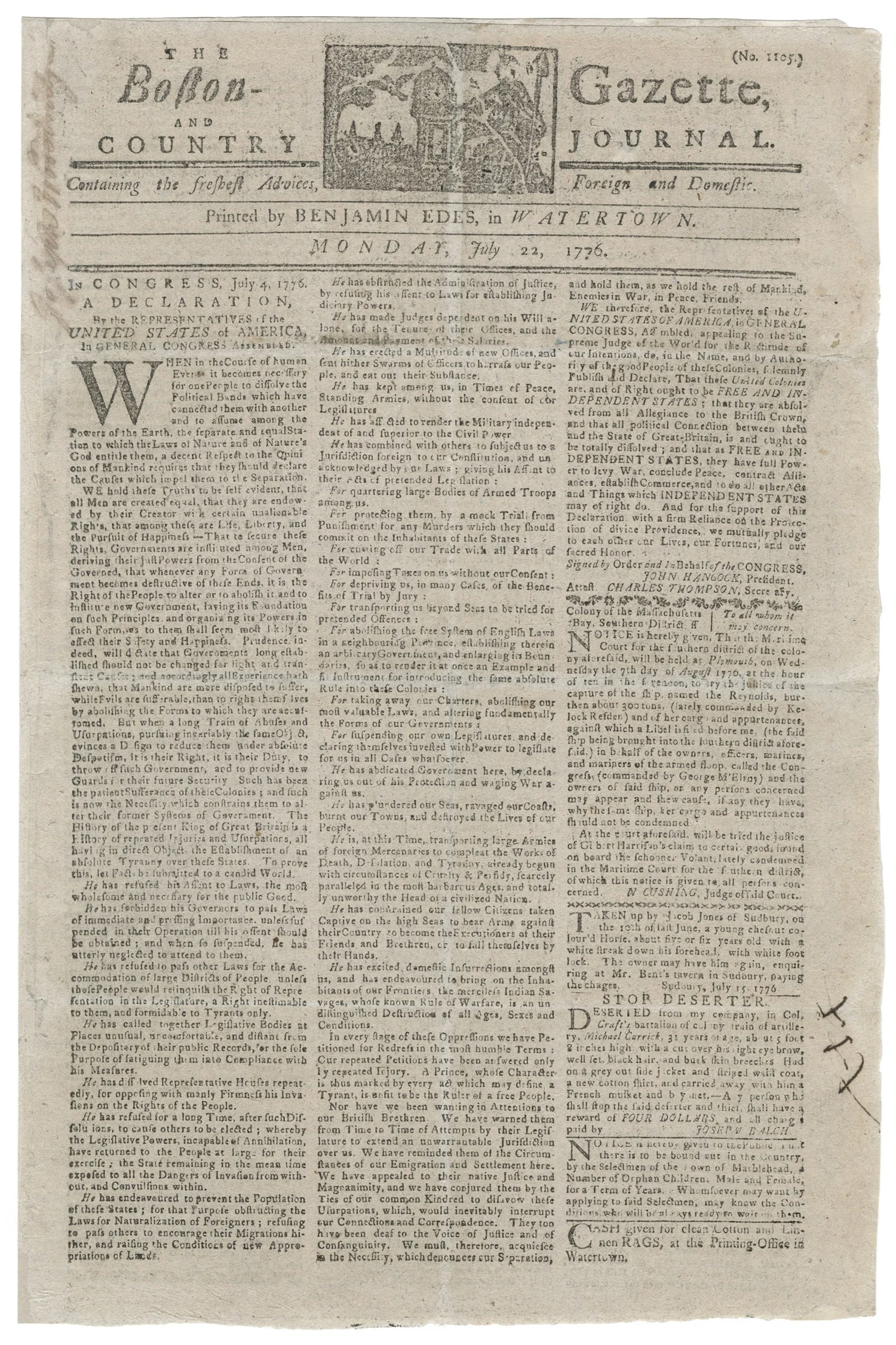
[DECLARATION OF INDEPENDENCE]. The Boston-Gazette, and Country Journal, July 22, 1776. Watertown, MA: Benjamin Edes. Original provenance: Joseph Woodridge (subscriber’s name written along top left margin). The Declaration appears here beneath a masthead engraved by Paul Revere. The publisher probably received the Declaration’s text in Boston on Thursday or Friday July 18 or 19, so this issue from Monday, July 22, was his first that could carry the news.