
 Image 1 of 1
“We hold these truths to be self-evident, that all men are created equal, that they are endowed by their creator with certain unalienable rights, that among these are life, liberty and the pursuit of Happiness…”
In the greatest break-up note in history, when the Signers of the Declaration of Independence proclaimed that self-evident truth, they knew their words described an aspiration, not a reality.
Even the most progressive of the Founders were constrained by the prejudices of their day. Despite their limitations, they put their lives on the line to support novel ideas about human rights and the revolutionary concept that a government should exist to benefit its citizens rather than its rulers.
For much of the last 250 years, “all men are created equal” was seen positively as an inspiration to progress. Today, many focus on the Founding Fathers’ hypocrisy, mistakes, and shortcomings. That diminishes the centrality of the Declaration to the reputation and history of America as a beacon to expanding liberties here and around the world. By looking at it through the lens of The Promise of Liberty, perhaps we can find a better balance.
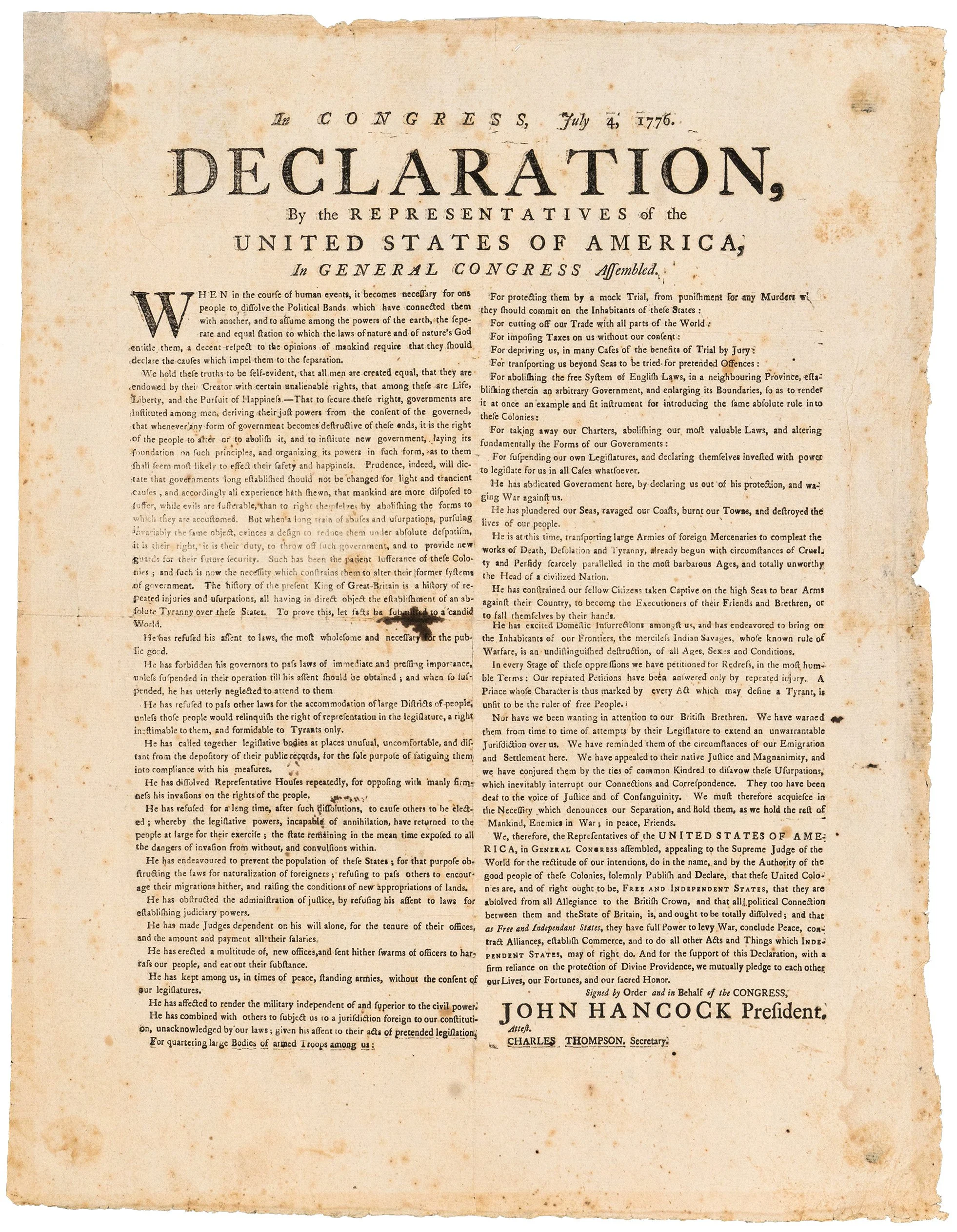
DECLARATION BROADSIDE, EXETER, NEW HAMPSHIRE
This is one of five July 1776 broadsides that do not identify their printer or place of publication. Provenance is one clue to the origin. Of the ten known copies of this edition, five have provenance back to the 18th century: three from New Hampshire, and two from Newburyport, MA, which is six miles from Exeter, NH.
In 1947, Frederick Goff, chief of the Rare Books Division at the Library of Congress, compared the text with that of the Declarations printed by the three known newspapers in the region. Goff concluded that the text here is most similar to that of the New Hampshire Gazette “Extraordinary” and thus attributed the present broadside to the same publisher.
[DECLARATION OF INDEPENDENCE]. Broadside in two columns. Exeter, NH: Attributed to Robert Luist Fowle. Ca. July 15-19, 1776. Including the present copy, there are ten known examples of this edition. Courtesy RallyRd.com. #21991